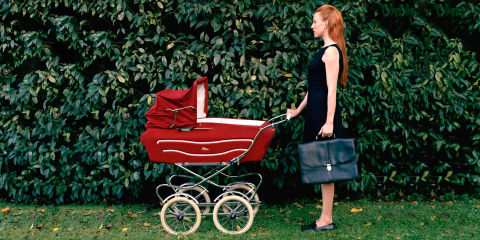
 GettyA woman only needs to announce her pregnancy and the inquiries begin: What are you going to do after the baby? Will you work or stay home? For so long the implication behind that question, when directed toward a woman for whom staying home is even a fiscally possible option, has been this: Are you going to choose you or your kids?
Old fashioned as it may sound, the belief that stay-at-home moms are better for their kids is one onto which many Americans cling. Recent research from PEW tells us that a third of us think that mothers who don't work are best for their children, while just 16 percent say a mother who works full time is ideal.
Advertisement - Continue Reading BelowStudies on the Working Mom long assumed that she is bad for her kids—all that remained was figuring out just how bad. Now some social scientists are flipping these assumptions on their head, looking instead at the way working moms might actually benefit their kids. And their findings are something to celebrate.
Leading a study for Harvard Business School's new Gender Initiative, professor Dr. Kathleen McGinn found that girls with working mothers have more fruitful careers; they also earn more and climb higher than their peers who had stay-at-home mothers. This means that if you want your daughter to be a #bossbabe, the best thing you can do for her is get to work.
More From ELLE
Tell us a little bit about the study.
We used data collected by the International Social Survey Programme (ISSP) across 24 countries in Latin America, Europe, North America, and Asia to study the influence of maternal employment on adult children's work and home outcomes. Looking at survey data from over 20,000 women, we found that being raised by a mother who worked outside the home is associated with positive outcomes for women at work and at home. Daughters of mothers who worked outside the home for pay at any point before the daughter was 14 years old are on average more likely to be employed, hold supervisory responsibility at work, earn higher income, and spend fewer hours engaged in household work each week than daughters of mothers who never worked outside the home for pay when the daughter was under 14 years old. That said, mothers' employment does not significantly affect the number of hours adult women spend weekly caring for family members.What is the impact on boys?
For men, being raised by a working mother doesn't influence outcomes at work, but is significantly related to time spent caring for family members. Compared to sons of mothers who never worked outside the home when the son was under 14 years old, sons of mothers who worked outside the home spend more hours caring for family members each week, on average.Did these findings surprise you?
It's straightforward that daughters of working moms are more likely to work themselves. But the increase in likelihood of supervisory responsibility for daughters who chose to work surprised us. This suggests that working moms are signaling more than "it's normal for women to work outside the home"; they're also signaling that it's normal for women to be powerful, to be in charge. This hasn't been explored before, as far as I know.Any sense of why this is the case? Is it the role model effect, or something more?
We've run a series of analyses to pinpoint why we see this pattern of results–positive career outcomes for women and positive outcomes at home for men. It's a role model effect along two dimensions: Working moms affect their children's gender attitudes, their beliefs about behaviors that are "right" and "normal" for women. We see evidence of this in measures of gender attitudes, too."Adult children of working moms have much more egalitarian gender attitudes."
than adult children of moms who stayed home full time. Working moms also model a set of skills, ways of managing an active life at home and at work. We're currently investigating the relationship between working moms and their children's work/home coping skills as adults.

没有评论:
发表评论